Bindery: where the bookish build community

A platform for bookish tastemakers


From exclusive content and book clubs to the collaborative publishing of entirely new voices, Bindery empowers tastemakers and their communities to elevate and celebrate stories that deserve to be read.

Tastemaker Waitlist
How It Works

Sad Rich Girl Salon is a ✨luxury✨ product (that is going to bankrupt itself)

image

It is enormously flattering when someone asks me to do a Sad Rich Girl Salon online or to do it in [their city], but this will not be happening any time soon. I'm very sorry if you're not near NYC but taking srgSalon on the road or online would diminish the quality and I hate low-quality anything.

I wish online was not such a paltry version of real life. If you've been on a zoom date or done a zoom class or zoom cocktail party-- you know I'm right. It doesn't compare.

Teaching on zoom is hell. There's no real time feedback. You don't know if people are silent because they're doing something else, totally distracted, on their computer or because they hate you and think your class is trash. And that's the people with their cameras on. The majority of people have their cameras off. Imagine if a stand-up comedian did a show (I know they did this during covid) and had to perform an entire set without any reactions. Madness.

If you still think an online Salon might be "better than nothing", let me give you the live music example. For a musician I'm a huge fan of, yes I will tune into a livestream of their concert. But recognizing how big the gap is between the online experience and the concert in-person experience --and now extrapolating this massive, massive chasm to the Salon and considering that OnlineSalon vs IRLSalon would have a proportionate gap - I can't do it. It would be unacceptable to release something so subpar just because it's easy enough to set up a stream.

I shut down the discord

precisely because of my hatred for low-quality. I didn't have time to manage it well and I definitely needed to be active and present (it never reached flow state/autopilot) for it to feel alive. I don't want something that is very much mine to have a lackadaisical presence.

Scaling anything these days feels like a gross thing

It's the Private Equity of it all. Making things bigger because they are trendy/liked/promising ruins them. I can't tell you how much i despise blank street coffee (and 787). A blank st opened a block away from me and seeing this irl symbol move-fast-break-things makes me cringe.

image

I'm not a blackpink head but private-equity-style expansion is what happened to that group. They're popular so their team works them to death-- makes them tour so much that they get sick (I could've sworn I saw a headline that said one of them passed out on stage while performing- but I can't find it) and they're falling apart but still being pushed BECAUSE they have a shelf life.

In a way, being forced to stay visible in this high-octane way shows a lack of faith from backers. Why can't the band rest and push the tour out a year? why can't blank street grow slowly and deliberately? because they (financiers) don't think it has any staying power. the $ people are thinking of it as a trend and expect the trend to die out imminently. They don't believe in the product, they're manically trying to eke out as much profit for themselves as they can- not realizing (or actually i think they do) that they're destroying it in the process.

I believe in my salon.

Not necessarily that it has the ability to expand into a giant empire but that it's the right format the way it is now. It's a high-effort high-quality thing (a luxe good!) and to pervert that in any way would mean it's no longer the thing i want it to be. Mass produced SRG salon is just crappy discussion group.

I don't believe in my content-

not in the same way as my salon. The salon has legs, it could go somewhere. It could evolve. Content (by which I mean short-form content, 2 min videos etc) is so limited. I've been making worse and worse content (lower effort, less time, less thoughtfulness) because 1) it doesn't change my views/stats and 2) I get to spend more time working on fiction. In fact (and I hope the significance of the following really makes you consider the habit of scrolling) making "worse" content has made my account grow faster. My content since mid February has been sloppier. I'm less concerned about anticipating rebuttals and countering them. I'm essentially letting myself be stupid-er and the algorithm is rewarding me.

Isn't that heinous?

Gene Pressman of Barneys (rip) said:

"Never give the customer what they want because they don't know what they want." This is what I feel about online SRG salon. It sounds like it'd be a good alternative- why not? just livestream it. But people aren't grasping that what the salon promises (and, i think, has delivered so far) is good conversation with interesting people. This would never translate online. You could watch the first 30 min talk of me+friend but the part that I think is the most valuable is the small discussion groups. The fact that so many people linger and continue chatting with each other long after the official event is over is what makes me consider it a success.

It's not just about "cheapening" my brand

That's part of why I don't want to do an online salon, certainly. I don't want to be associated with something that isn't up to my standard. But it's the idea of treating the salon as a "product" that feels ick. We're so accustomed to thinking in terms of brand building and how this salon is "leverage" that can make me look good in the eyes of the industry (maybe a magazine will do a profile on the salon! maybe i will be invited to a podcast!)

Like it's this "asset" that I have that i am not "capitalizing" on enough.

But the salon isn't an asset. It's not something I ever want to think of as a service i am providing. Honestly, I think what makes it good and interesting and valuable is rooted in a certain selfishness. I started a discussion group (unemployed girls club🤪) last summer because I wanted to talk to people who were interested in the same things I'm interested in. People who have the same cultural touch points so i dont have to explain what "west village girl" is (shots fired at my husband, sorry) -- and i found them. and it was a great convo. and I enjoyed it tremendously and so I continue to do the salon for my own enjoyment.

image

Just because people express a desire for something that you could potentially provide (and let's say they're even willing to pay for it) doesn't mean you should offer it. I think of Ratatouille and how when Gusteau dies, his name is immediately slapped on a bunch of frozen food that he would never have approved. People are clamoring to buy Gusteau frozen meals- but they'll probably be disappointed.

It's like all the Target collabs! I remember being SO excited for the Victoria Beckham one. And then being horrified by how bad the quality was-- but also. what did i expect? of course it's a polyester monstrosity- it was $30.

image

I swear to god ^^ this must have been a custom version of the target look that her team made special for her in better fabrics (and obv tailored to her tiny size). I bought this entire outfit and it was a disaster.

My salon will probably die before it gets big -- and that's how i prefer it. I'm way more likely to be like those directors who disavow their movies because they feel the studio or whoever is interfering with their vision.

If you are available on March 30th- come to the next salon and see for yourself if it's as magical as I'm claiming it is💖

To Have & Have More (2025)
January & February Disability Release Round Ups!

Hello and welcome to the combo January & February disability release! I’m so sorry about how late this is–but it is here, and we’ve got 13 books from January and 12 from February, so let’s get into it!


January Disability Releases

Tidespeaker by Sadie Turner*

Representation: autism

Genre: YA fantasy


The Magic of Untamed Hearts by Raquel Vasquez Gilliland

Representation: autism

Genre: paranormal romance


For Our Next Song by Jessica James*

Representation: ADHD

Genre: romance


Next Level Love by Shameez Patel

Representation: ADHD, anxiety

Genre: romance


Worst Case Scenario by Ray Stoeve

Representation: OCD

Genre: YA romance


Sap and Secrets by Daphne Elliot

Representation: PCOS

Genre: romance


King of Ravens by Clare Sager

Representation: chronic illness

Genre: fantasy romance


The Re-Do List by Denise Williams

Representation: chronic pain

Genre: romance


Alison’s Adventures in Time by Laura McAsh

Representation: mental illness

Genre: YA science fiction


Sparking Fire Out of Fate by Brigid Kemmerer

Representation: amputee, PTSD

Genre: YA fantasy


Finding Bliss by Kay Claire

Representation: autism, ADHD

Genre: romance


A Falling Star Enchantment by Anne Rollins*

Representation: autism (undiagnosed)

Genre: historical romance


Puck Me Tonight by Liz Lincoln*

Representation: I really cannot find information with specifics, but the author said every book in this series has some form of disability representation

Genre: romance


February Disability Releases

Until the Clock Strikes Midnight by Alechia Dow*

Representation: bipolar disorder

Genre: YA fantasy romance


And the Ancestors Sing by Radha Lin Chaddah

Representation: mental illness (PTSD?)

Genre: historical fiction


It’s All in Your Head by Sabina Nordqvist*

Representation: idiopathic intracranial hypertension, chronic pain, depression, + so much more

Genre: romance


And Now, Back to You by B.K. Borison

Representation: anxiety, panic attacks

Genre: romance


Pucking Tempest by Liz Lincoln*

Representation: chronic illness

Genre: romance


Gluttony: The Dominant Sinner by Christi Caldwell*

Representation: autism

Genre: historical romance


One Last Thing Before You Go by Caroline Frank

Representation: endometriosis

Genre: romance


The Fall Line by Meg Riley

Representation: arthritis

Genre: romance


According to Plan by Christen Randall

Representation: ADHD

Genre: YA romance


Cloud Nine by Amanda Sinatra

Representation: PCOS

Genre: romance


This Safe Darkness by Alexis Maragold

Representation: chronic migraines

Genre: dystopian fantasy


The First Five-Star Book of My 2026 Reading Year!

My five-star drought is over, huzzah! My thirteenth book completed in 2026 has delivered the elite goodness and I’m gonna tell you all about this certified banger. This one came with high praise from people that I trusted and it exceeded my expectations for several reasons, so let’s talk about drum roll

Everyone Who Is Gone Is Here: The United States, Central America, and the Making of a Crisis by Jonathan Blitzer

image

This promised to trace how migration between the United States and Central America has developed across decades of policy and conflict, focusing heavily on the countries most tied to those migration waves: El Salvador, Guatemala, and Honduras. It mainly moves from the Cold War-era civil wars of the 1970s and 1980s to the immigration battles of the 2010s and COVID’s impact in the early 2020s.

“Each of the last three American presidents dealt with a major humanitarian emergency at the border, and each time the American public experienced it as a separate incident. Once came in 2014, the next in 2019, and the third in 2021. The latest crisis was always the worst, until the next one. But these were all different chapters of the same story, which went back to 1980.” - pg. 5

The most impressive aspect of this book is that Blitzer accomplishes something rare in the nonfiction genre. I read a lot of doggone history books and only a few have pulled this off as masterfully as Blitzer. So the book is constructed to engage two very different readerships at the same time. One thread is a very human-centric navigation of the immigration system, told through asylum seekers, lawyers, families, etc etc, and you get to know these folk and their fascinating stories extremely well.

The other thread unpacks the policy that governs those lives, so you’re looking at political machinations, court decisions, and the various watershed moments of reform. Deploying both of those to tell this history is a thin needle to thread but Blitzer does a remarkable job balancing both, which is why I think this book works for both a general audience and a more academic readership. It’s my guess that this is at the core of why it’s so well received in both circles.

That structure allows Blitzer to explore multiple angles within his time scale. Immigration debates in the U.S. often miss the forest for the trees. It’s all about the latest headline or whatever some grifting asshole is screeching about to create division. Stretching that timeline out across forty years, Blitzer connects refugee law, deportation policy, gang violence, and the asylum system into a single evolving story that directly impacts his subjects (the people) and subject (immigration).

Blitzer returns often to the theme of unintended consequences. Policies meant to solve immediate pressures reshape the system years later in ways nobody saw coming:

  • Refugee reforms under Jimmy Carter created the modern asylum system, a framework that later made reaching U.S. territory the critical threshold for entering the asylum pipeline.

“The new US Refugee Act– designed to help immigrants persecuted for their membership in a ‘particular social group’ – was marking the Salvadorians who sought protection under it. To have set foot in the US, then been cast back out into the war zone, led straight to government-sanctioned murder.” - pg. 68

  • Deportation expansions in the 1990s under Bill Clinton sent thousands of people tied to gang culture in Los Angeles to countries such as El Salvador, where, ah shit, there’s fertile ground for networks like MS-13 to grow into even bigger monsters

“American deportation policy had turned local street gangs from LA into an international criminal network. MS-13 and 18th Street fanned across the country and the region; their rivalries spread with them, mutating into something even more violent and ungovernable. The Clinton administration was so eager to demonstrate its toughness on crime that it had deported hardened criminals without warning the Salvadorian authorities.” - pg. 261-262

  • Barack Obama’s aggressive deportations ran alongside humanitarian programs, capturing the constant tension between pragmatism and idealism.

“Less clear was where the lines of pragmatism blurred into conservatism. In October 2006, just a few months after supporting an immigration-reform bill that passed the Senate, Obama joined an eighty-vote majority to greenlight the construction of seven hundred miles of fencing along the border.” - pg. 274

  • Even moments that hinted at big change, such as the failed 2013 bipartisan Gang of Eight immigration bill, faded when Speaker John Boehner declined to bring the bill to a vote.

Blitzer’s thesis is that these moments did not happen in isolation and that there’s a direct line to be drawn back to around the time of Carter’s reforms. That is the cause for debate but he argues his case well enough.

And you may have noticed that Democratic presidents feature heavily on that bullet point list. One of the other things that impressed me about Blitzer’s approach was his willingness to take all the administrations to task. Yes, he digs in on Donald Trump and Stephen Miller, which I’m sure most would expect coming into this.

“Miller’s approach struck even the ideologues as idiosyncratic–and risky. In his view, the more controversial the administration’s immigration policies were, the more easily it could divide and conquer the electorate. He had scared Republican House leaders in 2013 by caricaturing Democrats and moderate Republicans as advocates for ‘open borders’; now he aimed to send the same message from the White House.” pg. 325-326

I never got the sense that Blitzer was in the tank for either side, which is a rare thing in these times of hyper-partisanship. This approach worked for me because instead of pausing to moralize, he simply laid out the pre-existing circumstances, what call was made in the moment, who made the call, and what followed.

Looking at what I’ve covered in this review, I feel I’m severely lacking in detailing how well and with such respect Blitzer told the stories of Juan Romagoza, Eddie Anzora, Lucrecia Hernández Mack and Keldy Mabel Gonzáles Brebe de Zúniga. Keldy, for example, had four siblings murdered by hitmen when she made the decision to head to the US and was one of the first parents separated from their children at the border due to Trump’s zero-tolerance policy for undocumented immigrants.

We simply cannot afford to ignore these stories when talking about immigration policy, and they are threaded throughout the book, tugging at you the entire way. So while the policy history does well to explain the system and its challenges and failings, it’s this part that demonstrates what it actually means to be wrapped up in that system.

For me, that combination of rigorous reporting, human storytelling, and historical sweep is what made this book so informative and essential.

If you’ve read this one already, I’d be curious where you landed on Blitzer’s thesis or how you felt about the book overall. If you haven’t read it, hopefully I’ve convinced you to pick it up.

Sapphic Romance Exists in More Than One Shelf

Romance readers often treat genres like a set of tidy little boxes. Contemporary romance sits in one place. Fantasy in another. Science fiction in another. Mystery somewhere else. If you walk into most bookstores, those sections all have their own shelves and places in the store.

Sapphic romance does not follow those rules.

One of the strangest things I hear from readers is this sentence. “I want sapphic romance but I cannot find any good ones.” I hear this from people who read ten or twenty romances a month. At first, I thought the problem involved visibility. Publishing. Marketing. Recommendation algorithms.

Then I started looking at reading habits.

A lot of readers search for sapphic books only within the contemporary romance category. That search misses a huge portion of what sapphic writers are doing. Many of the most interesting, delicious, beautiful sapphic love stories live inside fantasy, science fiction, historical fiction, mystery, and other genres.

So I want to spend some time wandering through those shelves with you.

Not as a definitive guide. More like a curious reader poking around and asking questions.

Contemporary sapphic romance

This is the shelf most people check first. Contemporary romance focuses on modern life. Workplaces. cities. small towns. messy families. dating apps. community spaces. awkward first dates. soft domestic moments.

Many contemporary sapphic romances center on identity. Coming out. Chosen family. Learning how to communicate needs. Learning how to exist in a world that does not always recognize queer relationships.

The setting remains familiar. The emotional stakes stay grounded in everyday life. That familiarity makes the love story feel immediate.

You watch two women/femmes try to build something steady while dealing with family expectations, career pressure, and their own emotional baggage. Sometimes the most satisfying stories come from watching people figure out how to care for each other better.

I love contemporary romance for this reason. You get to watch people grow. But honestly, it’s my least favorite subgenre of romance. I couldn’t tell you why, but I end of gravitating to fantasy and science fiction more and more these days.

Fantasy sapphic romance

Fantasy takes the rules of this world and throws them out the window.

Instead of navigating modern society, characters deal with magic systems, political alliances, ancient curses, rival kingdoms, and magical creatures who probably have opinions about the situation.

The love story takes place in a world that operates differently from ours.

Fantasy creates room for authors to reshape gender roles, social norms, and power structures. Some worlds hold no rigid expectations about gender or sexuality. We diverge from heteronormative and ciscentric ideologies. Others still contain those systems but allow characters to challenge them directly.

You might see princesses falling for rival generals. Court mages quietly falling in love while the kingdom teeters on the edge of collapse. Two warriors on opposite sides of a war slowly realizing they care about each other.

The stakes feel large. The feelings still remain deeply human.

Science fiction sapphic romance

Science fiction pushes things even further.

Instead of medieval kingdoms, you get starships, distant planets, artificial intelligence, time travel, or societies built around entirely different ideas of family and partnership.

Science fiction often asks strange questions about identity.

What does gender look like in a society that evolved differently from ours?
How do relationships function in a space colony where survival depends on cooperation?
What happens when technology changes the body itself?

A sapphic love story in that context forces readers to rethink what love even looks like.

Sometimes two characters fall in love while exploring alien worlds. Sometimes they meet across timelines. Sometimes they exist in a future where the rules of society look nothing like the ones we inherited.

And I find that deeply fascinating.

Historical sapphic romance

Historical romance does something equally important. It looks backward.

For a long time, people acted like queer women barely existed in earlier centuries. That claim collapses the moment you start reading historical fiction written by people who actually researched queer history.

Queer women existed in every time period. They wrote letters. They formed partnerships. They built quiet communities. They hid. They resisted. They survived.

Historical sapphic romance brings those lives into the foreground.

You often see secret relationships. Hidden meeting places. Social rules that force characters to move carefully. Sometimes the tension of those restrictions makes the romance even more intense.

Two people trying to love each other inside a world designed to prevent exactly that.

There is something powerful about reclaiming those stories.

Then there is the Bridgerton effect: historical romances that rewrite history to be more accepting. Romances that focus on classism or struggles of living off the land in a wild frontier, rather than on love being forbidden.

Mystery and thriller sapphic romance

Then you have romance that develops while people solve crimes or try to stay alive.

Mystery and thriller plots create immediate pressure. Two characters investigate a case together. They share danger. They rely on each other under stressful conditions.

Trust develops quickly in situations like that.

Detectives who start as reluctant partners. Journalists uncovering corruption together. Investigators who slowly realize their professional partnership has turned into something much more personal.

The emotional tension grows right alongside the plot.

And honestly, forced proximity during a murder investigation remains one of my favorite romance setups. In my opinion, there aren’t enough of these. I want psychological thrillers with sapphic subplots and women who fall in love with the serial killer they are hunting.

Why this matters

When readers only search for sapphic romance in one genre, they miss most of the field.

Sapphic writers tell love stories in every genre imaginable. Some focus on soft domestic intimacy. Others build entire worlds around queer relationships. Others explore history or future societies.

Genre shapes how these love stories unfold.

Fantasy allows writers to imagine entirely new social systems. Science fiction questions the very structure of identity. Historical fiction recovers erased lives. Mystery places love inside moments of danger and urgency.

All of those approaches expand how we think about queer relationships.

And frankly, they make reading more fun.

Your turn

I want to hear from you.

Which genre holds your favorite sapphic romances?
Which genres do you want to explore more this year?
What books would you recommend to other readers who want to branch out?

I am also asking this question for a practical reason.

This year I want to read widely across genres, especially speculative fiction. If you know a sapphic fantasy or science fiction book that rearranged your brain chemistry in the best possible way, please tell me about it.

Your recommendation might end up in the next review, the reading challenge, or even a future Sapphic Sunday book club discussion.

Next post will include some book recommendations from each of these sub-genres that I have read and loved, and some that are on my TBR.


Our March Newsletter Needs You! 🍃

image

It's time to populate our MARCH Cozy Quill/Traveling Tomes Newsletter with all your creative inspirations! Hopefully you were able to glance at the newsletter sent out yesterday and get an idea of what we're building. It will continue to grow and sharpen up, but it felt so meaningful! Thank you to all who submitted in February.

Our March theme is: A GENTLE THAW🍃. The Spring season is upon us and with it comes a thawing and an awakening. I wanted to feel that in the newsletter this month, so feel free to fill it with any examples of light entering, growth happening, and all the good things blooming.

Feel free to share: 

  • A small sign of growth or change in your life (big or tiny) that made you smile this month.

  • A cozy ritual, hobby, or creative moment that helps you feel lighter as winter thaws.

  • A book rec, piece of writing, or project that has a theme of blooming or becoming.

  • A photo of something emerging, blooming, or just quietly beautiful around you.

  • A recipe that suits the spring.

If you'd like to submit a piece for the newsletter, I'll be accepting through Friday, March 27th. The newsletter will be released to all of our Cozy Quill tiers at the beginning of the following month.

If your submission isn't chosen due to space limitations or whatever reason, please know we'll be creating a channel in the Discord to share those as well if you permit.

All the info you need is in the form below, but please don't hesitate to comment below with any questions. xx, Meg

Ready to submit?
CLICK HERE TO ACCESS THE GOOGLE FORM

5 Horror Books By Women I'm DYING to Read

Carnalis by Tiffany Morris

You know I was obsessed with Tiffany's Indigenous sapphic swamp horror novella Green Fuse Burning, so I cannot wait to dive into Carnalis!

Wealthy party girl Lauren hungers for human flesh. Her girlfriend Alex, a recently injured dancer, is trapped in Lauren's toxic and deadly spiral. The looming threat of capture may prove to be less dangerous than Lauren herself and the lengths she will go to satiate her needs. Will Alex be next on the menu?

Rich bitches? Cannibalism? My favorite!

The Curse of Hester Gardens by Tamika Thompson

We Need to Talk about Kevin as if written by Jason Reynolds and Tananarive Due meets Model Home by Rivers Solomon in an innovative twist on the haunted house novel: about a mother desperate to protect her sons from the twin specters of gun violence and otherworldly menace in their public housing project.

Haunted house horror in the projects? Are you kidding me right now?

Also, blurbed by one of the greats: “Ringing with lyricism and suspense, The Curse of Hester Gardens is a compelling vision of the horror of trying to raise sons in public housing haunted by violence. Despite ghosts and the uncanny, the true terror is the trap of poverty, which tests a mother's love to its limits. Tamika Thompson's sharp characterization and insightful storytelling make this a must-read.” —Tananarive Due, Los Angeles Book Prize and Bram Stoker Award winner, The Reformatory

Indigent by Briana Cox

Live-in handyman Xavier seems to be the only one who notices. Or cares. After a chance encounter with the culprit leaves him infected with something horrifying, Xavier is thrust into a surreal nightmare of starvation and consumption all too familiar to his gentrifying Atlanta neighborhood.

Succumbing to his infection, Xavier is drawn into the cobbled-together family squatting in Leigh Pierce's basement. People who, through a myriad of doomed roads, fell into the same self-destructive cycle of indigency, harboring dark secrets... and darker appetites. Trapped in a dynamic of codependency and complicity, Xavier and his family- new and old- are forced to confront the cost of survival in a world that has disregarded them.

A horror that goes after healthcare? Yeah. Sign me up right now.

Aviary by Maria Dong

A young woman undertakes a terrifying journey―and a terrifying transformation―in this genre-blending speculative suspense novel set in South Korea and the US which mixes fantasy, gothic vibes and queer longing, with a shot of feminist body horror.

This is a horror about violence, power, exploitation and transformation. NEED.

The Sea Hides Its Dead by Megan Bontrager

Trapped in an underwater cave, a group of academics must face a series of deadly, supernatural trials—each one demanding they confront their darkest sins—in this chilling aquatic cult horror debut

Academics studying a sea cult? Trials underwater in a cave to survive? Inject it into my veins. This is crazy.

Will you be adding any of these to your TBR?

As a reminder, any book purchased through my bookshop this month, benefits Black Walnut Books, an Indigenous, Woman and Queer owned bookstore. Check these books out below!

Reading the World: Albania

image

Non-fiction

  • "To the Lake" by Kapka Kassabova
    By exploring on water and land the stories of poets, fishermen, and caretakers, misfits, rulers, and inheritors of war and exile, Kassabova uncovers the human destinies shaped by the lakes.

  • "Free" by Lea Ypi
    Family and nation formed a reliable bedrock of security for precocious 11-year-old Lea Ypi. She was a Young Pioneer, helping to lead her country toward the future of perfect freedom promised by the leaders of her country, the People's Socialist Republic of Albania. Then, almost overnight, the Berlin Wall fell and the pillars of her society toppled. The local statue of Stalin, whom she had believed to be a kindly leader who loved children, was beheaded by student protestors.

  • "Indignity: A Life Reimagined" by Lea Ypi

    The author of Free returns with an extraordinary inquiry into historical injustice, dignity, truth, and imagination.

Poetry

  • "Negative Space" by Luljeta Lleshanaku

    Personal biography disperses into the history of an entire generation that grew up under the oppressive dictatorship of the poet's native Albania.

  • "Haywire" by Luljeta Lleshanaku
    In Haywire she turns to the fallout of her country's past and its relation to herself and her family. Through intense, powerful lyrics, she explores how these histories intertwine and influence her childhood memories and the retelling of her family's stories.

Fiction

  • "A Girl in Exile" by Ismail Kadare
    A Girl in Exile, first published in Albanian in 2009, is set among the bureaucratic machinery of Albania's 1945-1991 dictatorship. While waiting to hear whether his newest play will be approved for production, playwright Rudian Stefa is called in for questioning by the Party Committee. A girl - Linda B. - has been found dead, with a signed copy of his latest book in her possession.

  • "The Palace of Dreams" by Ismail Kadare
    A dystopian novel often interpreted as a critique of totalitarian regimes.

  • "Misinterpretation" by Ledia Xhoga

    In present-day New York City, an Albanian interpreter reluctantly agrees to work with Alfred, a Kosovar torture survivor, during his therapy sessions. Despite her husband’s cautions, she soon becomes entangled in her clients’ struggles.


    🗺️If you want to see more book recommendations from all the countries in the world, check out my Reading the World Spreadsheet.

    And if you want to support this project, consider becoming a paid member of my Bindery!

Early Thoughts on the Women's Prize for Fiction Longlist

When I decided to read the longlist for the Women's Prize for Fiction, I didn't realize how many I'd have already read and loved! That confirms my commitment to read the rest (most of which haven't been published in the US, or at least not yet). Here are my thoughts on those I've already read. I think that every one of these has earned it's placed on this list, and has important things to say about our world today.

Wild Dark Shore by Charlotte McConaghy 5/5 Stars This was my first Charlotte McConaghy. I loved the balance between an intriguing plot and well-drawn characters.

The Correspondent by Virginia Evans 5/5 Stars One of my favorite books I've read so far this year. The characters really come to life through this epistolary novel.

Heart the Lover by Lily King 5/5 Stars This made me ugly cry. I love Lily King's writing.

Moderation by Elaine Castillo 4.75/5 Stars This one I was most surprised to be on this list, but it's a very pleasant surprise. I need more people to read this dystopian book on the future of content moderation. It also has a lot to say about immigrant labor.

A Guardian and a Thief by Megha Majumdar 4.5/5 Stars I'm still thinking about this one. This is not a happy read, but a necessary one.

Audition by Katie Kitamura 4/5 Stars Katie is one of my favorite authors but this is actually my least favorite of hers. This one is unique and will leave you thinking.

Flashlight by Susan Choi 3.75/5 Stars This is a well-written book with a plot that is a little clunky. Not surprised it's on this list.

Dominion by Addie E. Citchens 3.5/5 Stars I'm happy to see this book on this list, though it was a hard read for me with my background in the evangelical church.

A Beast Slinks Towards Beijing by Alice Evelyn Yang 3.25/5 Stars I think I read this at the wrong time for me. I did enjoy the discussion of living with memory loss.

Ancestral Tarot by Nancy Hendrickson Schedule | READALONG

Hi all! Although I originally wasn't planning on reading a witchcraft related book together immediately, and instead had plans for some non-fiction reads (which we will still get to), I just started reading Ancestral Tarot and it is a perfect book for discussion.

A practical, hands-on guide for using tarot to connect with your ancestors and gain access to their insights for healing, self-protection, and personal powers.

With a tarot deck in hand, readers will learn how to identify and access ancestral gifts, messages, powers, protectors, and healers.

Tarot expert Nancy Hendrickson guides readers through the basics of finding recent ancestors, and navigating the confusing maze of DNA and ethnic heritage. As a longtime tarot enthusiast, she shows readers how to incorporate a metaphysical tool into a world of tradition.

Ancestral Tarot spreads are included in relevant chapters. Each chapter includes three journal prompts that lead readers into self-discovery around ancestral gifts, wounds, and patterns they may have inherited. The better we know our ancestors, the better we know ourselves.

I've already read the first few chapters and there are a number of spreads that aren't overly complicated. I'd love to hear what others' experiences are with it. The readalong schedule will coincide with the seasons, as that is how my life is operating these days, but you can read at your own pace, with the seasonal outlines being a guide or deadline if that helps keep you on track.

Now through March 20: through Chapter 2

March 21 - May 1st: through Chapter 4

May 2 - June 21: Chapter 5

June 22 - August 1: Chapter 6

August 2 - September 22: Chapter 7

September 23 - October 31: Chapter 8 & 9

November 1st - December 21: Chapter 9 & 10

December 21 - February 1: through the end

There will be a discussion channel in Discord so join there if you haven't already and would like to discuss as you read. I will also be making posts about my own experiences as I read.

There is a bit in the book about choosing which ancestors to work with first, so some chapters may be read only for information vs completing exercises, so with that in mind, we may finish the book sooner than this above timeline depending on how people work through it.

Looking forward to discussing this one with you!

Ronnica fatt

Visit Site

Ronnica Reads

Ronnica fatt

Committed to celebrating books from marginalized authors, with an emphasis on diverse books that lean literary.

Tasj

Visit Site

Littrilly Reads & Chats Club

Tasj

Hello & welcome to Littrilly Read & Chats Club (LRCC)! <3 I’m Tasj! Here to help you find reads that enlighten, comfort, and excite! Expect: book recs, Book reviews, bookish diaries, reading vlogs, book club, and literary exploration

Reading Fools

Marston Quinn

I’m a fool, and so are you, but maybe we'll be a little less foolish if we read great books together?

Collectible Science Fiction

Adam

Welcome to CSF! Home of the coolest books and covers.

Carlos osuna

Visit Site

The Threaded Library

Carlos osuna

The Threaded Library isn’t just a book club — it’s a creative, cozy, and wonderfully queer corner of the internet where stories and art intertwine.

Boozhoo Books

Boozhoo Books

Cracks in an Ocean of GlassWhat Feeds Below
Naomi

Naomi


Tastemaker-curated publishing imprints


We partner with select tastemakers to discover resonant new voices and publish to readers everywhere.

Tastemaker-curated publishing imprints

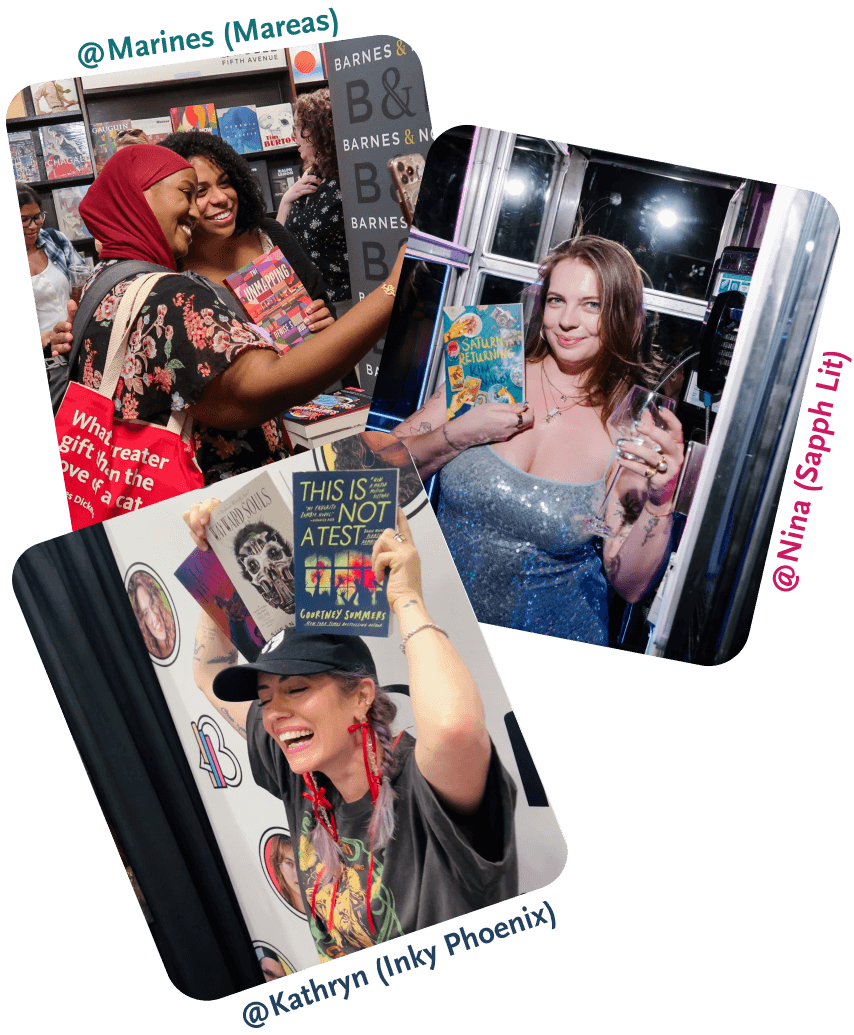
Mareas

Cover for Our Sister's Keeper

Our Sister's Keeper

Jasmine Holmes

Sapph-Lit

Cover for Saturn Returning

Saturn Returning

Kim Narby

Boundless Press

Cover for Burn the Sea

Burn the Sea

Mona Tewari

Left Unread Books

Cover for Devil of the Deep

Devil of the Deep

Falencia Jean-Francois

The Inky Phoenix

Cover for Wayward Souls

Wayward Souls

Susan J. Morris

Ezeekat Press

Cover for Black as Diamond

Black as Diamond

U.M. Agoawike

The Inky Phoenix

Cover for This Is Not a Test

This Is Not a Test

Courtney Summers

Mareas

Cover for Orange Wine

Orange Wine

Esperanza Hope Snyder

Boundless Press

Cover for Dust Settles North

Dust Settles North

Deena ElGenaidi

Cozy Quill

Cover for Recipes for an Unexpected Afterlife

Recipes for an Unexpected Afterlife

Deston J. Munden

The Inky Phoenix

Cover for Local Heavens

Local Heavens

K.M. Fajardo

Left Unread Books

Cover for Cry, Voidbringer

Cry, Voidbringer

Elaine Ho

Violetear Books

Cover for Tempest's Queen

Tempest's Queen

Tiffany Wang

Skies Press

Cover for To Bargain with Mortals

To Bargain with Mortals

R.A. Basu

Fantasy & Frens

Cover for Crueler Mercies

Crueler Mercies

Maren Chase

Ezeekat Press

Cover for Of Monsters and Mainframes

Of Monsters and Mainframes

Barbara Truelove

Mareas

Cover for The Unmapping

The Unmapping

Denise S. Robbins

Violetear Books

Cover for Black Salt Queen

Black Salt Queen

Samantha Bansil

Ezeekat Press

Cover for House of Frank

House of Frank

Kay Synclaire

Violetear Books

Cover for Inferno's Heir

Inferno's Heir

Tiffany Wang

Fantasy & Frens

Cover for And the Sky Bled

And the Sky Bled

S. Hati

The Inky Phoenix

Cover for Strange Beasts

Strange Beasts

Susan J. Morris

Join Bindery

Bindery is currently admitting new tastemakers who want to build bookish communities
Get the Bindery app

Download on the App StoreDownload on the Play Store

As Seen In