Bindery: where the bookish build community

A platform for bookish tastemakers


From exclusive content and book clubs to the collaborative publishing of entirely new voices, Bindery empowers tastemakers and their communities to elevate and celebrate stories that deserve to be read.

Tastemaker Waitlist
How It Works

MEMBERS WATCH EARLY — Readinng Wrap-Up — January 2026
Jaysen
White Comfort Over Truth

Comfort over truth

White supremacy culture prioritizes comfort, especially white comfort. This shows up when tone becomes more important than content. It shows up when anger, grief, or directness from Black and Brown women is labeled as unsafe, aggressive, or inappropriate.

Comfort over truth sounds like:
Can you say that more nicely.
I agree, but the way you said it was harsh.
I am open to feedback, but not like this.

This shifts focus away from harm and toward managing white emotional experience.

Reflective journaling:
How were you taught to relate to anger or strong emotion, especially from women of color.
What messages did you receive about politeness, niceness, and being likable.
How has that shaped whose emotions you take seriously.

Intent over impact

White supremacy culture teaches individualism and defensiveness. Many white women are taught to focus on intent. If harm was not intended, then harm feels up for debate. This moves the conversation away from the person harmed and toward protecting white identity.

Intent over impact sounds like:
That was not my intention.
I did not mean it that way.
You misunderstood me.

Intent does not erase impact. Accountability asks for attention to what happened, not just what was meant.

Reflective journaling:
What happens in your body when your impact is named.
What stories do you tell yourself to feel less responsible.
What would it feel like to stay with impact without explaining.

Tone policing and emotional control

White supremacy culture values emotional restraint and control. Black and Brown women are often punished socially for expressing anger, urgency, or pain. White women are often rewarded for calmness and softness. This creates a dynamic where white women feel entitled to set the emotional rules.

Tone policing sounds like:
I would listen if you were calmer.
I agree with you, but you are being too intense.
Let’s keep this productive.

This treats emotional expression as the problem instead of the harm being named.

Reflective journaling:
Who taught you what emotions are acceptable.
Whose emotions feel threatening to you and why.
How do you benefit from being seen as calm or reasonable.

Moving Toward Accountability and Relational Repair
Shifting these patterns requires more than intellectual agreement. It requires nervous system work, relational skills, and a willingness to tolerate discomfort without centering yourself. Accountability asks white women to build capacity for staying present when feedback feels activating.
This means learning to notice defensive impulses without acting on them. It means resisting the urge to correct tone, explain intent, or manage your image. It means staying focused on the harm named, even when your body wants to escape, justify, or shut down.
Practically, this can look like.
Listening without interrupting or correcting.
Naming impact before intent.
Saying, “I hear you. I caused harm,” without adding explanations.
Asking what repair would look like.
Sitting with discomfort without making it someone else’s problem.
This is not about perfection. It is about practice. Each moment of staying with impact builds capacity for real relationship. Each time you choose accountability over comfort, you weaken the systems that depend on white emotional centrality.
This work is not abstract. It shows up in friendships, workplaces, therapy spaces, activism, and family systems. It shapes who feels safe to speak and who feels pressured to stay silent. Choosing truth over comfort is a daily practice. It is relational. It is embodied. It is ongoing.
February Book Club

I tried to pick some different genres, but always feel free to send me suggestions! Choose your top pick by 2/1

The Heaven and Earth Grocery Store

In 1972, when workers in Pottstown, Pennsylvania, were digging the foundations for a new development, the last thing they expected to find was a skeleton at the bottom of a well. Who the skeleton was and how it got there were two of the long-held secrets kept by the residents of Chicken Hill, the dilapidated neighborhood where immigrant Jews and African Americans lived side by side and shared ambitions and sorrows. Chicken Hill was where Moshe and Chona Ludlow lived when Moshe integrated his theater and where Chona ran the Heaven & Earth Grocery Store. When the state came looking for a deaf boy to institutionalize him, it was Chona and Nate Timblin, the Black janitor at Moshe’s theater and the unofficial leader of the Black community on Chicken Hill, who worked together to keep the boy safe.

As these characters’ stories overlap and deepen, it becomes clear how much the people who live on the margins of white, Christian America struggle and what they must do to survive. When the truth is finally revealed about what happened on Chicken Hill and the part the town’s white establishment played in it, McBride shows us that even in dark times, it is love and community—heaven and earth—that sustain us.

There Is No Place for Us: Working and Homeless in America

The working homeless. In a country where hard work and determination are supposed to lead to success, there is something scandalous about this phrase. But skyrocketing rents, low wages, and a lack of tenant rights have produced a startling phenomenon: People with full-time jobs cannot keep a roof over their head, especially in America’s booming cities, where rapid growth is leading to catastrophic displacement. These families are being forced into homelessness not by a failing economy but a thriving one.

In this gripping and deeply reported book, Brian Goldstone plunges readers into the lives of five Atlanta families struggling to remain housed in a gentrifying, increasingly unequal city. Maurice and Natalia make a fresh start in the country’s “Black Mecca” after being priced out of DC. Kara dreams of starting her own cleaning business while mopping floors at a public hospital. Britt scores a coveted housing voucher. Michelle is in school to become a social worker. Celeste toils at her warehouse job while undergoing treatment for ovarian cancer. Each of them aspires to provide a decent life for their children—and each of them, one by one, joins the ranks of the nation’s working homeless.

Through intimate, novelistic portraits, Goldstone reveals the human cost of this crisis, following parents and their kids as they go to sleep in cars, or in squalid extended-stay hotel rooms, and head out to their jobs and schools the next morning. These are the nation’s hidden homeless—omitted from official statistics, and proof that overflowing shelters and street encampments are only the most visible manifestation of a far more pervasive problem.

All the Colors of the Dark

1975 is a time of change in America. The Vietnam War is ending. Muhammad Ali is fighting Joe Frazier. And in the smalltown of Monta Clare, Missouri, girls are disappearing.

When the daughter of a wealthy family is targeted, the most unlikely hero emerges—Patch, a local boy, who saves the girl, and, in doing so, leaves heartache in his wake.

Patch and those who love him soon discover that the line between triumph and tragedy has never been finer. And that their search for answers will lead them to truths that could mean losing one another.

Famous

Meet Lance. Thirty-eight years old. Works a meaningless job. Still lives above his parents’ garage. By all accounts, a world-class loser. Save for one glaring exception: He has a million-dollar face.

Lance has been mistaken eighty-seven times for the Oscar-winning movie star James Jansen, and for the last ten years, he’s saved his money and studied Jansen’s films, his moves, his idiosyncrasies—even the way he speaks. Now, after an unceremonious termination from his job, Lance has decided that the time has come to go after his dream of truly becoming Jansen.

From New York’s avant-garde, off-off Broadway scene to the glitter of Los Angeles, Lance embarks on a journey toward becoming James Jansen that will take him closer to the star than even he had dreamed—and to darker lengths than he could’ve possibly imagined.

Artemis

Jasmine Bashara never signed up to be a hero. She just wanted to get rich.

Not crazy, eccentric-billionaire rich, like many of the visitors to her hometown of Artemis, humanity’s first and only lunar colony. Just rich enough to move out of her coffin-sized apartment and eat something better than flavored algae. Rich enough to pay off a debt she’s owed for a long time.

So when a chance at a huge score finally comes her way, Jazz can’t say no. But engineering the perfect crime is just the start of her problems—because her little heist is about to land her in the middle of a conspiracy for control of Artemis herself.

Trapped between competing forces, pursued by a killer and the law alike, she’ll have to hatch a truly spectacular scheme to have a chance at staying alive and saving her city.

Jazz is no hero, but she is a very good criminal.

That’ll have to do.

Q1 Book Club Poll

Hi everyone, hope your Januaries have been good so far! Apologies for the lack of activity on here this month - work has been crazy, but will definitely be trying to post more in the upcoming months!

In book club news, I’ve decided to shift our book club from a monthly rhythm to a quarterly one, with the hope that this slower pace will allow for more intentional book choices and richer discussion, while making it easier for everyone to join in! We’ll continue to center fantasy and science fiction books by authors of Asian descent, with each quarter featuring a blend of backlist favorites and new releases (and for Q1, I also threw in a manga option because why not 😌). 

So without further ado, here are brief blurbs about the selections for Q1!

Immortal Longings (Chloe Gong)
Inspired by Shakespeare’s Antony and Cleopatra, Chloe Gong’s adult epic fantasy debut is a fiery collision of power plays, spilled blood, and romance amidst a set of deadly games.

The Poet Empress (Shen Tao)
A rice farmer turned concubine must survive the dangers of court, learn to read in secret, and compose the most powerful spell of all to save herself and the nation.

To Bargain with Mortals (R.A. Basu)
A stunning reflection on politics and purpose, blood and allegiance - and what we do with the histories we inherit, following an outcast heiress, a notorious gang leader, and a country on the brink of revolution.

The Promised Neverland (Kaiu Shirai) 
In a manga that blends elements of science fiction, thriller, and dark fantasy, a group of orphans uncover a dark truth and must escape a macabre fate before it’s too late.

image
A Confession

image

My book comes out in a few months, and I am terrified. I am scared that no one will read it. I am afraid that it is not good, but at the same time, I am afraid of what it might mean if it is. I worry people will not want to engage with it because it is poetry, and poetry so often carries the connotation of being confusing, structurally strange, or too intellectual for casual reading.

And I hate that.

I am drawn to writing that is emotionally deep but simple enough to understand. Work that is not buried under fancy language just to appear complex or sophisticated. I have always said poetry is the only way I know how to take complicated emotions and turn them into something digestible. I do not believe poetry should push people out. It should invite them in and ask them to sit with it. Poetry, to me, should be a bridge between the heart and the reader, not a locked door.

My book, The Apple of Their Throat, is my third collection but my first traditionally published one. My first book, Shelter, was self published in 2018, and looking back, it makes me smile and cringe. It was written in the middle of a breakup and reads like an unfiltered emotional diary. At the time, I was trying to emulate what I would call Instagram poets. I did not understand structure or line breaks, but I knew what I felt and I tried to translate that as honestly as I could.

Then, in 2024, I self published another collection as a small passion project called The Transformation of Fruit. That book was more mature and more intentional, but still messy and still raw.

Over the last six years, I submitted my work for publication and was rejected again and again. I revised, restructured, rewrote, and wrote entirely new poems, all of which eventually led to The Apple of Their Throat. Looking back, I was not ready to be published. I do not think my writing was bad. It was just unstructured, raw, and a bit directionless. With The Apple of Their Throat, I found what I wanted to say, how to say it, and how to do so in a way that respected my ethos of what poetry can be.

The Apple of Their Throat is a love story. To the self. To old religions. To love itself and to heartbreak. I call it a memoir in verse because, in many ways, it is. It is my life and my story, but once it is on the page, it no longer belongs to me. I would not even say it is ours. These words belong to you now.

The poems may be specific to my experience, but the emotion beneath them is universal. That is my hope, that you feel that universality when you read them. My partner, who is not religious, once told me that the poems he connected with most were the religious ones. That surprised me, but it also confirmed what I have always believed. When the emotion is true, the subject does not matter.

This book is about love, heartbreak, family, queerness, selfhood, and the beliefs we internalize to find our place in the world. I fell in love with the symbolism of fruit, how it is considered the birth of sin and how queer people have been called “fruit.” And while these poems can be read in any order, they do tell a story with a full arc from the first page to the last.

I want to explain everything about this book to you, but I think now I have to let it speak for itself.

Pause before you speak

White Women. Pause Before You Speak.

When conversations about safety, harm, or oppression come up, many white women/femmes feel an immediate pull to respond. The response often feels caring, protective, or helpful. Underneath that urge, white supremacy culture often shapes what feels normal, responsible, or polite and we don't even realize it.

Tema Okun’s work on white supremacy culture names patterns that are baked into institutions and relationships. These patterns are not about individual morality. They are about systems that train white people, especially white women, to center comfort, control, and emotional safety in ways that silence or override Black and Brown women.

Decolonized therapy and healing justice frameworks add an important layer. These are frameworks I use in my own therapeutic practice. They remind us that harm is not only interpersonal. Harm lives in systems, bodies, and histories. Healing is not only about insight. Healing is about changing how power moves in relationships, whose nervous systems are protected, and whose pain is taken seriously.

Pausing is not passive. A pause is an active disruption of systems that reward speed, reassurance, and control.

Why the pause matters.

White supremacy culture often teaches urgency. Urgency pushes fast responses, quick fixes, and immediate reassurance. In conversations about harm or safety, urgency often serves white comfort more than Black and Brown safety.

Urgency sounds like:
I need to respond right now.
I should fix this.
I need to explain myself before I am misunderstood.

Healing justice asks whose nervous system is being prioritized. Decolonized practice centers the people most impacted by harm. A pause creates space to ask who benefits from speed. In many cases, speed protects white emotional comfort and social standing, not the person naming harm.

Reflective journaling:
What emotions come up when someone names harm connected to race or safety?
What do you feel pressure to protect in those moments. Your image. Your relationships. Your sense of being good?
Where did you learn that being quick and calm equals being safe?

Stay tuned because I have a LOT more on this to come.

Also check out the source material https://www.whitesupremacyculture.info

Maya Gabrielle

Visit Site

Won't Calm Down

Maya Gabrielle

It's about to get weirder... and louder. Probably gayer. Here, we rave loudly and unapologetically about what brings us joy, and we refuse to calm down. Happy to have you :)

Stuff Celine Reads

Celine

collector of books, words and stories 🍂🗝️

Kaden Love

Author and reader

Welcome you beloved Imps! If you like dark fantasy, insane sci-fi, or my novels about cyberpunk tooth-eating vampires, you're in the right place.

Bob Stuntz

Visit Site

DocoftheDarkArts

Bob Stuntz

📖 Reader, former ER doctor prescribing fantasy, horror, and sci-fi. 📚 Bookish thoughts, reviews, and recs

The Page Ladies

Visit Site

The Page Ladies Book Club

The Page Ladies

Welcome to The Page Ladies Book Club! A place to share our book clubs and our individual reads! So come dive into our reviews, join the discussion, and find your next great read!

Boozhoo Books

Boozhoo Books

Cracks in an Ocean of GlassWhat Feeds Below
Naomi

Naomi


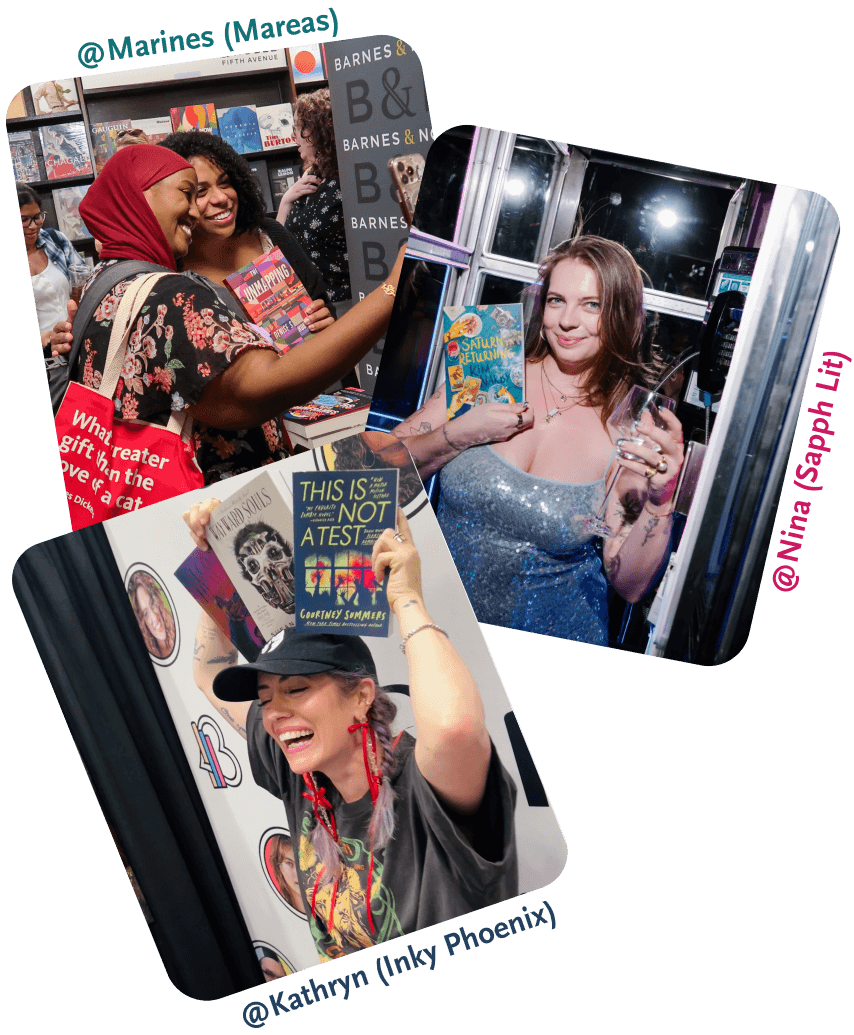
Tastemaker-curated publishing imprints


We partner with select tastemakers to discover resonant new voices and publish to readers everywhere.

Learn more
Tastemaker-curated publishing imprints

Mareas

Cover for Our Sister's Keeper

Our Sister's Keeper

Jasmine Holmes

Sapph-Lit

Cover for Saturn Returning

Saturn Returning

Kim Narby

Boundless Press

Cover for Burn the Sea

Burn the Sea

Mona Tewari

Left Unread Books

Cover for Devil of the Deep

Devil of the Deep

Falencia Jean-Francois

The Inky Phoenix

Cover for Wayward Souls

Wayward Souls

Susan J. Morris

Ezeekat Press

Cover for Black as Diamond

Black as Diamond

U.M. Agoawike

The Inky Phoenix

Cover for This Is Not a Test

This Is Not a Test

Courtney Summers

Mareas

Cover for Orange Wine

Orange Wine

Esperanza Hope Snyder

Boundless Press

Cover for Dust Settles North

Dust Settles North

Deena ElGenaidi

Cozy Quill

Cover for Recipes for an Unexpected Afterlife

Recipes for an Unexpected Afterlife

Deston J. Munden

The Inky Phoenix

Cover for Local Heavens

Local Heavens

K.M. Fajardo

Left Unread Books

Cover for Cry, Voidbringer

Cry, Voidbringer

Elaine Ho

Violetear Books

Cover for Tempest's Queen

Tempest's Queen

Tiffany Wang

Skies Press

Cover for To Bargain with Mortals

To Bargain with Mortals

R.A. Basu

Fantasy & Frens

Cover for Crueler Mercies

Crueler Mercies

Maren Chase

Ezeekat Press

Cover for Of Monsters and Mainframes

Of Monsters and Mainframes

Barbara Truelove

Mareas

Cover for The Unmapping

The Unmapping

Denise S. Robbins

Violetear Books

Cover for Black Salt Queen

Black Salt Queen

Samantha Bansil

Ezeekat Press

Cover for House of Frank

House of Frank

Kay Synclaire

Violetear Books

Cover for Inferno's Heir

Inferno's Heir

Tiffany Wang

Fantasy & Frens

Cover for And the Sky Bled

And the Sky Bled

S. Hati

The Inky Phoenix

Cover for Strange Beasts

Strange Beasts

Susan J. Morris

Join Bindery

Bindery is currently admitting new tastemakers who want to build bookish communities

Get the Bindery app on iOS

Download on the App Store

Android coming soon


As Seen In